Find out why your competitor gets named, and you don’t.
Google’s AI answers, the map pack, and the review count a buyer compares before calling all favor someone. I find out who, and why, with a fact you can verify yourself in under a minute.
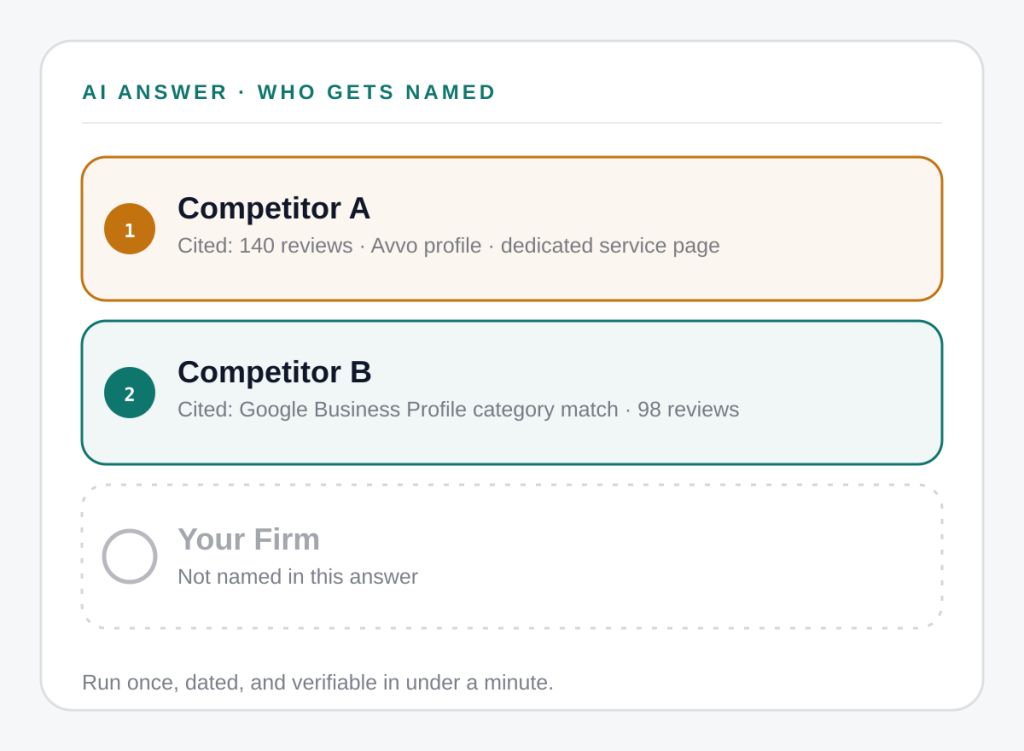
Small firms competing against names an AI answer already trusts.
I work with two kinds of owners who feel this the same way: the search names someone else.
Dental, chiropractic, physical therapy, and med spa practices
Owner-run, usually under ten staff. Patients check Healthgrades, your Google Business Profile category, and your review count before they call. If a competitor’s profile is fuller or their rating is higher, they get named first, in the map pack and in the answer a patient gets when they ask an AI assistant.
Estate planning, family law, and personal injury firms
One to ten attorneys, usually the managing partner making the call. Clients check Avvo, Justia, and FindLaw, and increasingly ask an AI assistant directly. If your practice-area page is thin or your Avvo profile is sparse, the AI answer has less to point to, and it points somewhere else instead.
I work remotely with firms across the United States. No local office, no regional limit.
The exact query, the exact answer, and who it names instead of you.
Every finding starts with a real search, run and dated, never assumed from a description.
- 01
The buyer query. The exact words a prospective client or patient types, run once and dated.
- 02
Who appears. The map pack, and the businesses an AI answer names or cites, with a source link where one exists.
- 03
What’s being cited. Review counts, directory profiles, service-page depth, the specific things the named competitor has that explain why they’re named.
If your practice already appears, I say so. A finding that isn’t real isn’t worth sending.
I hold my own work to the same standard I’m proposing for yours.
I don’t have client results to show yet. What I have is a live site, built and measured by the same rules: every claim dated, every number sourced, every fix verified on the rendered page, not assumed from a log.
The site is The Well Water Lab, an independent well-water education resource I built and run. Every statistic on it links to the source I opened to verify it. When I found the site’s own outbound email was failing authentication, silently, I didn’t take a green checkmark’s word for it. I read the raw headers, then read the delivery report Google itself generated afterwards, and confirmed the fix from both directions. That’s the standard I bring to a visibility diagnosis: dated, sourced, and checked at the layer you’d actually experience it.
These are facts about my own published work, verified on 2026-09-23. I have no paying clients yet. That’s stated plainly, not hidden.
A one-page look at what a real finding reads like.
This is a redacted example built to show the format, not a real client engagement. Every real snapshot follows this same structure: buyer queries, who appears, what’s cited, the gap, and one next step.
Fifteen minutes to hear what I found, or to ask me to look.
If you already have a finding in hand, we’ll talk about what it means. If you don’t yet, tell me your city and what you do, and I’ll look before we talk.
Frequently Asked Questions
It checks three things for the exact searches your buyers run: who appears in the map pack, who an AI answer names or cites, and what those competitors have (reviews, directory profiles, service pages) that your listing doesn’t. Each finding is run and dated, and you can verify it yourself.
Yes. I work remotely with law firms and healthcare practices across the United States. There’s no local office and no regional limit.
Then I say so. A snapshot for a practice that already appears states what’s working, not an invented gap. I’d rather tell you that than send a finding that isn’t real.
The first observation, a single named finding, is free and sent without obligation. Pricing for a full diagnostic or ongoing work is discussed once I understand the specific gap, because the right scope depends on what’s actually missing, not a flat rate.
Because you don’t have to take my word for it. Every fact in the Proof section above traces to a live page you can open yourself, and every finding I send you is built the same way: dated, sourced, and reopenable.